
third portal
✵☾ Gods and Monsters ☽✵

1.
I've been thinking about this thing we're writing, this dialogue. About Molly Bloom's monologue - 'I was a flower of the mountain, yes' - death by frostbite, and the angel of desire we talked about that day in Paris. Do you remember?
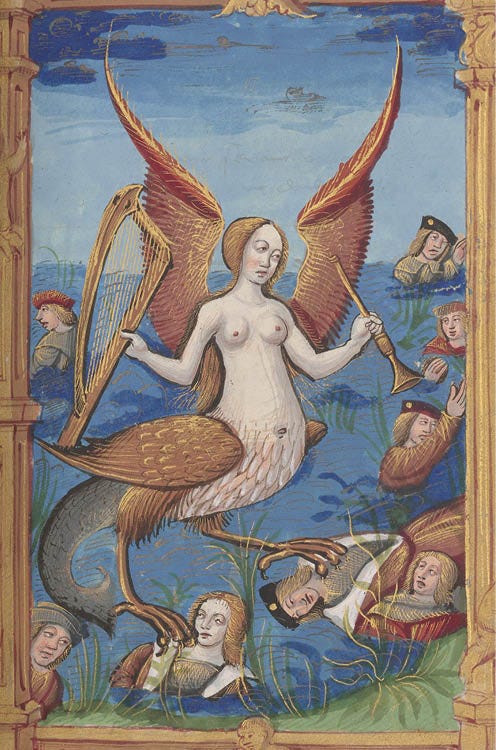
Did you know that in the Middle Ages, according to some scholars, monsters were thought to be messengers from the future?
In his Histoires Prodigieuses, Pierre Boaistuau writes: “Within Christianity, a monster was primarily a message. A monstrous body could be evidence of a previous sin, such as having had sexual intercourse in positions other than the missionary or having practiced bestiality. But a monster was also a message toward the future. A prodigy always was a news bringer.”
It made me think of our project because the monsters created by the minds of these medieval men and women represent (also) the unknown; the monsters were often inhabitants of distant lands, peoples they could not see, a way to negotiate with all that they did not understand and explore... I don't know... their desire, perhaps?
You said that “desire comes from the future, it's a vision of what can be”, and I would add: a vision of what might be in a distant, inaccessible place. These monsters attracted and repelled, and they were (also) an exercise in imagination and fantasy.
Is it possible for Desire to also inhabit the past?
On January 18th, 1915, Virginia Woolf wrote in her diary: "The future is dark, which is the best thing the future can be, I think.”
We've talked many times about this thing we're writing. You once said that my view of desire seemed a little negative, pessimistic, that I saw desire as an absence, a lack of something. I think you misunderstood me. My basic question remains this: Is desire something (a feeling, an impulse) that can be shared? Part of me thinks that maybe the answer is no, or that yes, it's possible, but only for very brief moments—moments in which we see the angel, in which we imagine or become a metaphorical monster. Or am I confused? What is desire? Inspiration? Falling in love? Enlightenment? Yearning? Lust? Monstrosity? Hunger?
Perhaps this confusion is because I inevitably associate desire with romantic love.
On my phone, I have a document called "portal" in which I scribble things I read in books, on the walls of buildings, or hear in songs, with the intention of returning to them later. I also have a folder full of pictures of portals: the falaises we saw in Normandy, an open window into a dark room, a whirlpool in the water. On May 4th, I wrote: "To see images outside ourselves: an ancient desire."
The problem is that I can't remember where I read it.
5.
Macbeth:
Stars, hide your fires;
Let not light see my black and deep desires.
William Shakespeare, Macbeth (Act 1, Scene 4)
Lady Macbeth:
Come, you spirits
That tend on mortal thoughts, unsex me here,
And fill me from the crown to the toe top-full
Of direst cruelty. Make thick my blood;
Stop up the access and passage to remorse,
That no compunctious visitings of nature
Shake my fell purpose, nor keep peace between
The effect and it!"
William Shakespeare, Macbeth (Act 1, Scene 5)
7.
It's as hot today as it was that day at the Mosquée, in Paris. We ordered iced tea and Tunisian pastries and sat outside. It was sunny and you began to talk about desire, about the angel who gives you a glimpse of the future, of possibility. I remember telling you that for me, more than a glimpse, desire is like a boundless ocean into which one sinks—an ocean where past and future converge in the only possible dimension: the present.
This episode’s playlist contains: Camille Saint-Saëns, Lana Del Rey, Beach House, M83, Explosions In The Sky and various religious chants.
Conversation on Desire is an ongoing invitation to speculate about the nature of desire
Follow us on Instagram.
Would you let us know what it is to desire for you? You can answer a very brief question here.